


Fine Art - Week One Reflections and Week Two Ideas
- Nov 22, 2017
- 4 min read


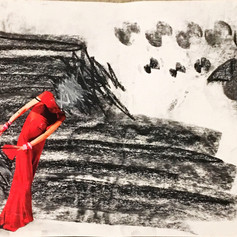







After much deliberation at my end of stage one assessment, I have decided to choose the fine art pathway. The final decision was between graphics and fine art, and although in my head I think graphics would have been a really interesting and fun pathway to choose, I think that due to the highly experimental and broad range of styles within my work, I may have found it too constricting and miss the more practical elements like painting and printing. I can however include elements of graphics into my fine art pathway, and intend to do so by working in my monochromatic and minimalistic style. I think it is important however, that i really stick to my guns and attempt to find my own creative style within fine art, as at the moment it is clear to me through the work I am producing that I don't have a specific artistic touch that makes my work recognisable as my own. However, this is obviously not something that can simply be found, and therefore I think this is an outcome to be achieved over a broader time scale, and in fact over the whole course. I think I can set this as my overall goal for this foundation year; to discover my style in terms of how I work, what materials I use, and the outcomes I want to create both visually and mentally in the sense of discovering what I want my work to evoke from the audience.
Upon being set our first task of "GATHER, ASSEMBLE, CONNECT" we explored several artists briefly being given small examples of each to try and fuel the start of our creative journey. Amongst all of the artists, the names that stuck out to me that I would like to research into further were (names linked to the artists pages for research) Lucy Mckenzi, Anthony Gerace, Will Redman, Jim Lambie, and Marina Ambramovic. Looking across these artists now, I think what would be and interesting way of generating ideas is perhaps to - after initial artist research - try and locate the connection between each artist and discover why they appeal to me, as in this way I will be able to discover what attracts me visually in art and what I subconsciously look for in other artists work.
I think I quickly discovered this week that in the initial stages of studio work, what is more important is to just keep creating and generate a high quantity of work, rather than creating detailed pieces that could be presented as final outcomes. It is important now to be highly experimental and try out things as broad as possible, in terms of materials, tools, resources and ideas. We were encouraged to look into working with things that perhaps aren;t seen as conventional art materials and I would really like to take this idea forwards. Looking at how some other people in the studio took this is interesting and inspiring, as people used tools such as strands of human hair as a paint applicator and rocks and branches as a substitute to paper. I am currently (in the second week of studio work) trying to think about how I could paint onto a Jenga set t make a comment on identity. My plan is to paint the bricks white, as I think visually the white will look nicer than the pale wood colour, and then paint a self portrait from 4 angles (front, left side, right side, and back) onto the block when they are standing. I am yet to decide whether to keep the piece loose so it can be an interactive piece, or to glue the block together. practically this would make it easier when I come to paint the self portrait onto the tower, however I was also thinking off writing on some extracts of nonsense diary writing I wrote on my typewriter a few years ago, as this would be a really interesting way to make it more of a personal piece about me, reinforcing the idea of the work commenting on identity.
However before I even come close to painting faces onto the blocks, I think it is vital to better my understanding of the human form, both in terms of the actual face and head itself, how it pieces together and created tone and shape, and also of painting in a more general sense as alongside drawing, i have never really looked at painting as a method of recording human life, because in the past I have worked a lot more with abstract processes and less conventional painting practitioners. I think now therefore, it is key to my development in this art process to explore some key painters who fall under my possible category and style of artwork. After talking to a tutor today, I have a list of artists to explore before launching into painting styles that match some of the previous artists I have looked at such as Andrei Protosuk. These artists include Käthe Kollwitz, Marlene Dumas, John Baldessari (in particular the Africa Remix exhibition), Amedeo Moditiani, and Fernand Leger. The questions I need to be asking when exploring these artists are how do they approach a subject, and how they resolve issues using their style.
It may also be beneficial for me both in terms of painting and in general artistic development to go back through the very basics of art history and perhaps explore the classic painters, to improve my knowledge of the practice. I always find tutors and my peers talking and making reference to such big names, and while I know their general style and can often name some of the works, I find that more often than not I am unable to draw a completed understanding of where the artist stands on a historic timeline, and therefore cannot grasp their work in my head.


Comments